Imprisoned at Guantánamo for 14 years despite being innocent, Mauritanian engineer Mohamedou Ould Slahi spoke at Columbia University in New York on the 25th anniversary of September 11, 2001.
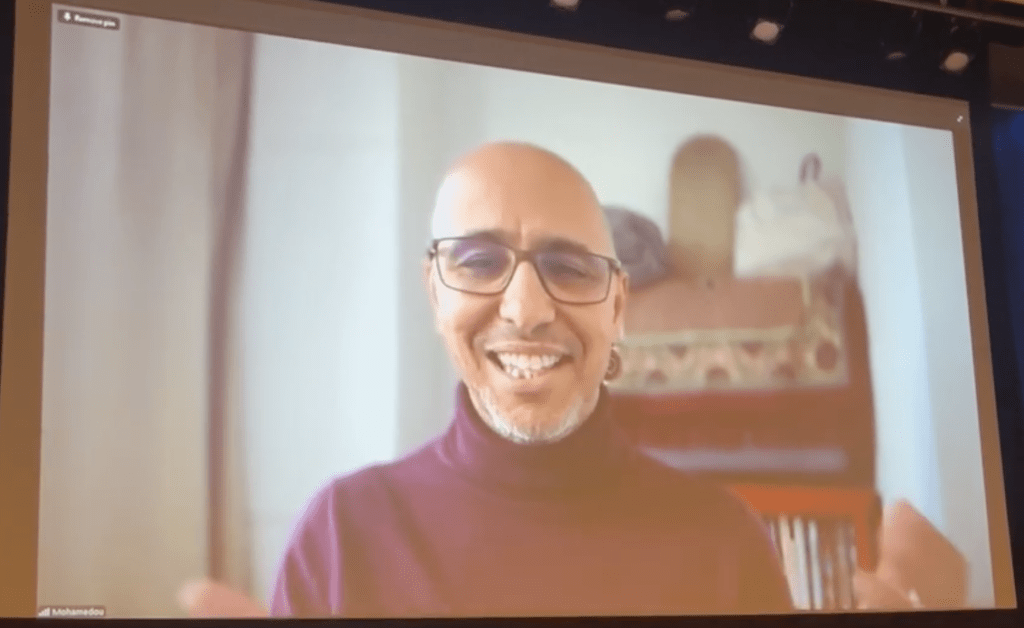
Mohamedou Ould Slahi’s life was turned upside down by the collapse of the Twin Towers in New York City on September 11, 2001. He could not have imagined at the time that the so-called “War on Terror” would cost him 14 years of imprisonment as an innocent man, first in Jordan, then in Afghanistan, and finally at Guantánamo, the infamous maximum-security prison for terrorists, considered by the U.S. government to be “the most dangerous in the world,” where he was subjected to torture and long periods of isolation.
In 2016, he was transferred to Mauritania after a U.S. commission authorized his release, determining that he did not represent a significant threat to the United States.
Today, despite his release, the consequences of his ordeal continue to limit his freedom of movement, while for years he was prevented from traveling freely outside Mauritania. The full testimony, complete with subtitles, can be viewed here, on The Review’s YouTube channel, followed below by the Italian transcript.
The interview is conducted by Spencer Davis, University News Editor of the Columbia Daily Spectator, a student of American Studies and Sociology and Jewish Ethics at the Jewish Theological Seminary, and a member of the Class of 2027.
Mohamedou Ould Slahi:
You don’t want to live the violence of the United States of America in Africa, when they ally themselves with the local dictatorship.
And yes, that’s how it is. I grew up under a military dictatorship, and my mother, obviously, was very protective, like any other mother. And she forbade us from talking about politics. My father died when I was 11, and she was left with 12 children whom she had to raise by herself.
And I remember when the police came to pick me up. They came in civilian clothes, and I was very scared, really very scared, because I know that these Mukhabarat are completely outside the rule of law. And Spencer, I would never have expected that very similar tactics would be used by the United States of America, not only at Guantánamo Bay, but years later inside their own land, in the United States of America.
It is so traumatic to see masked agents, without names, nothing. My mother told me, “I know why they came to take you.” She said, “Because you watch television. I told you not to watch television.”
Even today I never forget my mother’s face. As I watched her disappear in the rearview mirror of the car, I was inside and she disappeared. I really thought I would come back the same day, for Iftar, with everyone gathered around to break the fast. It was Ramadan.
It happened on September 11, and now I’m talking about November 20. Around four o’clock I disappeared, and I thought I would come back, but I never came back. I never saw my mother again. I disappeared. I was taken to different places: the first was Jordan, then I was taken to Afghanistan, and from Afghanistan I was taken to Guantánamo Bay.
I want to tell you something. I’ll conclude my answer with one thing. There is a very famous, at least in Europe, a very famous priest. His name is Martin Niemöller. And he famously said about the Nazis, when they came for the socialists: “I did nothing because I was not a socialist.”
When they came for the trade unions, I did nothing because I was not part of the trade unions. When they came for the Jews, and when they came for me, there was nobody left to defend me. And that is exactly my experience with this uncontrolled violence of the United States of America. I am not here to criticize the U.S., because I am a great lover of Americans.
So, no. But these actions by the government that give them a “blank check” to keep people from the Middle East and North Africa in prison, torture them, and keep them without any meaningful access to the law, to defend themselves, and ultimately to obtain justice for the victims of 9/11…
And when I see what is happening, I am really struggling against the impulse to feel Schadenfreude — pleasure at someone else’s misfortune — when I see these same tactics being used in democratic countries, and America is now leading this complete change to destroy what remains of international law.
Spencer Davis:
You know, Mohamedou, one of the things we have talked about, I think, in the context of this conference, is not only the War on Terror and its effect and the violence against people, but also its effect on the First Amendment, on your ability to speak, read, write, and think freely.
And at Guantánamo, initially you were given paper to write letters home. You said that when everyone else started receiving replies, you received a letter, supposedly from your parents, but you realized that it actually came from an American intelligence agency pretending to be your parents.
You said that when you wrote letters to your family from that point on, you were actually trying to communicate with American intelligence officials. What did you want to tell them? What message did you want to convey?
Mohamedou Ould Slahi:
When I think about it, I realized how naïve and, frankly, stupid I was then, inexperienced. And I wanted to challenge the CIA, challenge the FBI. I was trying to show them that I was intelligent enough. I knew that this is not how my mother speaks.
You know, we talk about languages, you know, and we talk about the mother tongue, the supreme language of your soul. It is like expressing your soul.
There is a French author, from Brittany, a French province. And in the thirties or forties she visited Mauritania. And she had someone helping her, someone you would today call a fixer. She could not read or write the language of the Tuareg. When she started writing, he would say, “Okay, greetings to… greetings to Mohammed, greetings to Mohtar.” She thought, “Okay, when is he going to finish with all those names?”
He would answer, “No, I have to complete the names.”
And this is what my mother would send me: just a lot of names. And these coded languages, only I can read them, and nobody else can read them. They tried to imitate my mother.
And because I was stupid, I took the letter and gave it back to the person interrogating me.
I said, “I don’t want, I don’t want to keep this thing that is not mine.” And they seemed surprised. Why?
What I regret is: why didn’t I keep those letters? Because those letters are very funny and I could use them for my writing, make comedy out of them.
And to answer your question: yes, I was communicating with intelligence. Because I knew they were monitoring everything, and recently I wrote a book called Approved by U.S. Forces, letters to and from my mother in Mauritania.
And I went back to read these dances that my mother and I performed. Not so much my mother, because my mother is direct. And so I could communicate with her through this filter and with the most powerful agencies in the world.
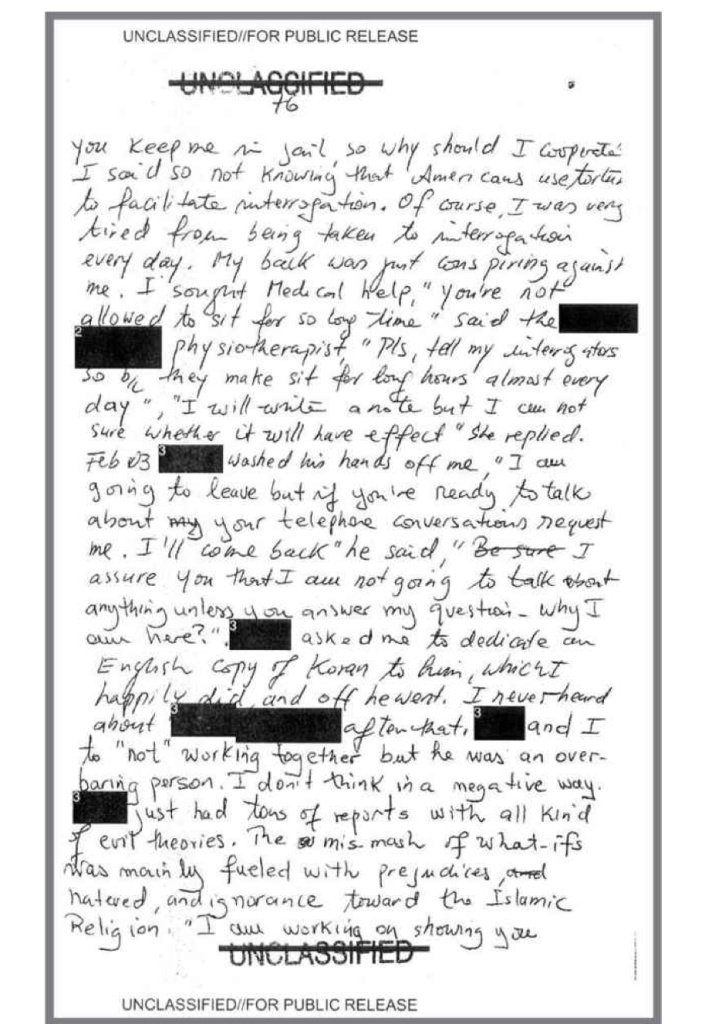
The text of Guantánamo Diary with more than 2,500 redactions made by the U.S. government.
Spencer Davis:
You talk about this, about the performance between you and your mother and the U.S. intelligence agencies. Part of that performance was that eventually you started secretly taking pens and sheets of paper from other prisoners. But, of course, the guards discovered it, they confiscated what you had written.
Why did you have the determination to continue writing, and how did you get through all of that?
Mohamedou Ould Slahi:
You know, there is this saying, how can we say, “Until the lion learns to write, the story will always be written by the hunter.”
And in Dutch they say… “Repetition makes things perfect.”
But what I say is: pain gives birth to art.
I have no training in art, Spencer.
I program, I am an engineer. I program and configure servers. But writing was imposed on me because the pain was such that I wanted to explode, you know, from pain.
Because, Spencer, you are young and you still believe in justice. I was young too and I believed in justice. Today I am not sure there is justice in this world, to be very honest.
I am not so optimistic about justice, because when we see what is happening, people dying under torture…
Dilawar was beaten to death in 2002, at the Bagram detention center in Afghanistan. The same prison where I was incarcerated.
And, you know, Gul Rahman was put in a refrigerator and died inside.
The same refrigerator where I spent the nights.
And I wanted to share with you the little story of the refrigerator, because when they put me in the refrigerator — the refrigerator is a very cold room, which we called the “refrigerator” — they kept pouring water over me. And they told me they would not stop until I talked.
But my problem was that I could not speak. I was so cold that I could not move my lips, not even to tell them, “Please, stop, I can’t take it.”
Every time I think about the scene I remember, I see why Gul Rahman died.
This performance, this communication with my mother, is my way of surviving. Because I needed contact with my mother. I almost went crazy. You know, I kept hearing voices…
I also want to comment on this. I was almost angry because I kept hearing voices. And this is strange because when you have been tortured, you are no longer a person.
And this is so serious on so many levels.
I mean, you cannot get reliable information from someone you torture. And you torture a human being and, much worse, you torture an innocent human being.
Spencer Davis:
While you were at Guantánamo in 2005, you were writing in English what became the 466-page manuscript, Guantánamo Diary. And you were writing in English, right? A language that was not necessarily your language.
You learned a lot while you were in prison. And every piece you wrote was, of course, automatically classified. And the manuscript was locked away for many, many years.
Now, what did it mean to write a book? One thing is writing letters to your mother, but a book is addressed to an audience that you know might never receive that message.
Mohamedou Ould Slahi:
You know, I define myself as an illegal immigrant, undocumented, who is not in the country. I have all the characteristics of an illegal immigrant. I don’t want to speak badly about America, I love American culture. I love the American people, but the government cannot stand me.
At least that is exactly what an undocumented immigrant is.
I am an undocumented immigrant, but the government cannot find me, because I am not there.
At the beginning, Spencer, I had no paper.
And I would like to describe myself… I would like to be a good Muslim myself. Even in our country we cannot steal. But there is nothing that says you cannot borrow.
That is exactly what I did.
There was a Yemeni, before they put me into total isolation. There was a Yemeni who was allowed to write letters; I was not allowed to write them.
I took his sheets through the mesh between us, I think, you know. I took his paper and wrote, and they took it away from me.
And I felt so much pain when I was not allowed to write.
And when I met my lawyer, Spencer, I was so thirsty to write that I exploded onto the paper and started writing.
And I wrote all these pages in six weeks, exactly six weeks.
And I remember a female lawyer, Silvia, perhaps she is here, she was upset. She said, “Why do you use both sides of the paper?”
It made me laugh.
It is a very American way. Because in America they use only one side. But in Mauritania I cannot afford to buy very much paper.
So I use both sides.
I write very small.
And there was very little time, because I wanted to put so much information in.
And yes, Spencer, writing is different from speaking because writing is telling stories.
And, you know, since I also write in Dutch, now I am doing a little self-promotion, I also wrote my screenplay in Dutch.
And I realized that you don’t need that much language to write.
You know, because you only need the story and you have to be brave.
And I was very brave.
Sometimes I did not know the next word, not the next sentence, the next word.
I would ask the guard to tell me.
“How can I say this?”
He would explain it to me and I would write it down.
Spencer Davis:
Are there still four books that you wrote there?
Mohamedou Ould Slahi:
Yes.
You know, Larry Siemens too, when he was communicating with me — and he was not allowed to communicate with me — he encouraged me to write more.
And then I started writing more.
But now I have many manuscripts written during these years of freedom.
And this, you know…
But we have to focus on one thing: without writing, I would never have been a free man.
Because literally, using, I think, Larry’s words, writing allowed me to sustain myself.
And that is exactly what oppressive regimes do not want, because they always want to decide the narrative.
“Who is Mohamedou?”
Mohamedou is a terrorist.
Al-Qaeda wants to destroy America.
The American people who hate the West.
By the way, I don’t know what the West is, by the way.
And Spencer, you should look for the photograph they used to publicize my arrest, with that ugly picture.
Even I would put myself in prison.
I mean.
Spencer Davis:
You know, let’s talk about this narrative.
When we spoke, you told me that the War on Terror essentially began with a promise to Americans.
Extraordinary powers would be used, rights would be violated, but only to target bad people who had done something bad to this country.
Was there a particular moment, during your detention or afterward, when you realized that the rules America had created for, in quotation marks, “bad people” could be used against innocent people like you or, you know, American citizens?
Mohamedou Ould Slahi:
Yes.
Spencer, you know it much better than I do.
The premise of democracy is not to trust the government.
That is the premise: the first thing is that you should not trust the government.
Do not trust them.
Give them very little power, to show their good faith and do something for the people.
And if they do not, we change them.
But what happened after September 11 is that people were traumatized.
My brother Larry is from New York.
Well, the atrocities of September 11 happened.
So people are really traumatized.
And people, if only tacitly, accept this illegality, you know, giving the government a blank check to do whatever it wants.
And you want it to do it against others, not against you.
And this makes me a very wise man, really.
And I think now we should always demonstrate for those who have no rights, like immigrants, you know, in this country, because they are the most vulnerable.
The government can come and take them.
Vulnerable people are the first line of defense.
And Americans have failed, like at Guantánamo.
Completely.
Spencer Davis:
Mohamedou, thank you so much for speaking with me and for addressing all of us. I really appreciate it. It has been an honor.
Mohamedou Ould Slahi:
Thank you, Spencer.
Caption:
Echo Camp at Guantánamo, isolation and interrogation cell.
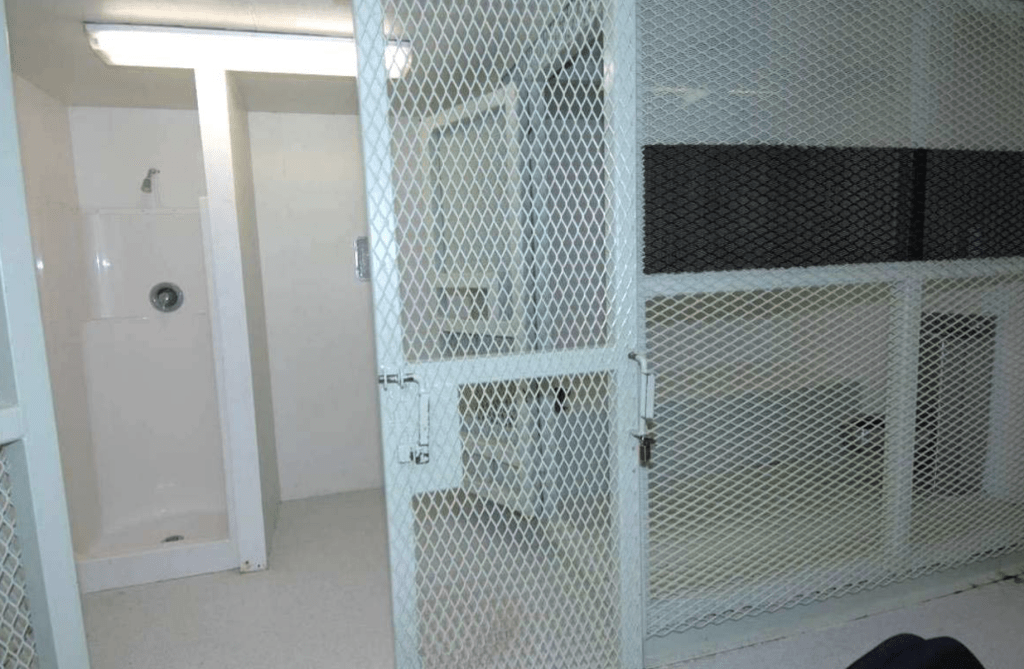
Echo Camp at Guantánamo, isolation and interrogation cell.