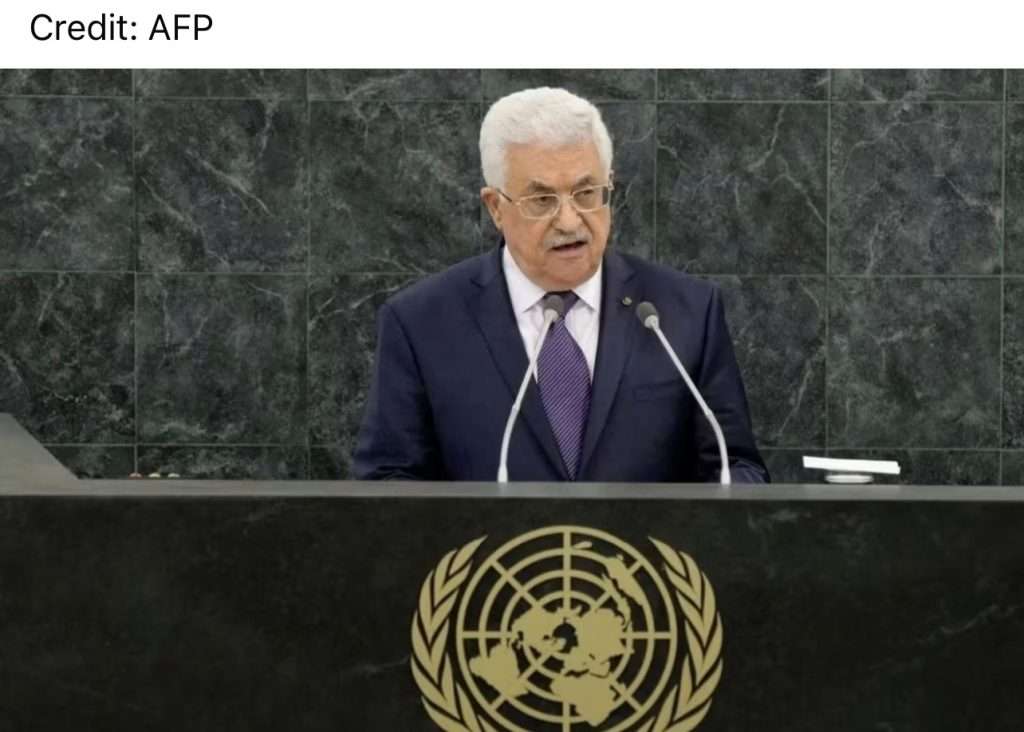
New York — For the second consecutive year, Palestinian Authority President Mahmoud Abbas will not set foot in New York for the United Nations General Assembly’s high-level week, after the U.S. State Department announced it is extending visa sanctions on Palestinian Authority (PA) and Palestine Liberation Organization (PLO) officials.
The State Department announced it will extend visa sanctions on officials of the Palestinian Authority and members of the PLO, preventing Abbas from traveling to New York ahead of his address to the UN General Assembly for the second year in a row. The decision, confirmed Thursday, also affects dozens of other PA officials who had hoped to travel with him.
According to the Times of Israel, one notice seen by a Palestinian official cited Section 212(a)(3)(B) of U.S. immigration law, which prohibits issuing a visa to anyone who has engaged in terrorist activities or been associated with a terrorist organization. Despite the ban, Palestinian representation at the summit will not disappear entirely. The Palestinians will still be represented at the high-level meeting by diplomats already accredited to the United Nations, and Abbas is expected to again appear by video. The State Department also said it would maintain a waiver allowing members of the Palestinian Mission to the UN to continue operating from New York.
The U.S. rationale
Without naming specific officials, the State Department said it would extend visa sanctions against Palestinian officials over actions taken to “internationalize the Israeli-Palestinian conflict,” including pursuing cases against Israel at international tribunals. The State Department’s statement also claimed the PA and PLO are working to advance measures against Israel at the International Criminal Court and International Court of Justice, are seeking to promote unilateral recognition of a Palestinian state, and are continuing payments to terrorists and “glorification of terror.”
The department accused the Palestinian Authority of trying to “internationalize” the Gaza war through international courts and other bodies. A State Department official separately said the restrictions stem from the PA and PLO’s “failure to reform, contrary to their commitments to the United States, and their ongoing activities that undermine the prospects for peace.”
Palestinian and UN reaction
Palestinian leaders rejected and condemned the move, Palestinian UN envoy Riyad Mansour told the General Assembly. In a statement, the Palestinian foreign ministry called it “an unjustified measure that runs counter to efforts to rebuild trust, develop Palestinian–US relations, and create the necessary political climate for implementing the two-state solution and achieving peace and stability.”
The Palestinian Authority separately said restrictions on its officials weaken the Palestinian side committed to a political solution and encourage efforts to undermine a two-state solution. Under the 1947 UN “headquarters agreement,” the U.S. is generally required to allow access for foreign diplomats to the UN in New York — a provision Washington’s critics say this decision breaches. Washington, for its part, does not recognize the Palestinian Authority as a full UN member, although the General Assembly and some UN bodies have recognized it.
Broader context
This is not a new fight — it’s a repeat of last year’s standoff. The last time Abbas addressed the UN General Assembly in person was in 2024. A similar visa denial last year forced him to address the meeting by video instead. After that 2025 denial, the UN voted to let Abbas address the General Assembly by video, with the measure passing 145-5 with six abstentions. That resolution applied only to the 80th session and explicitly stated it should not set a precedent for future sessions — an unusual arrangement that last year’s text itself described as exceptional, while stressing that Palestinian representatives should ordinarily be able to attend UN meetings in New York in person.
The precedent for barring a Palestinian leader from the UN goes back further still: in 1988, the U.S. denied a visa to PLO Chairman Yasser Arafat, prompting the UN to temporarily relocate its General Assembly session to Geneva so he could address it. A campaign to repeat that move this year has resurfaced — advocacy groups have urged the UN to again temporarily shift the session to Geneva to provide a platform for barred Palestinian delegates — but this remains an outside push rather than an adopted UN plan for 2026.
The dispute also lands amid a wider diplomatic shift: the Palestinian Authority’s efforts to gain international recognition have seen recent successes, with the UK, France, Canada, and other nations formally acknowledging Palestinian statehood