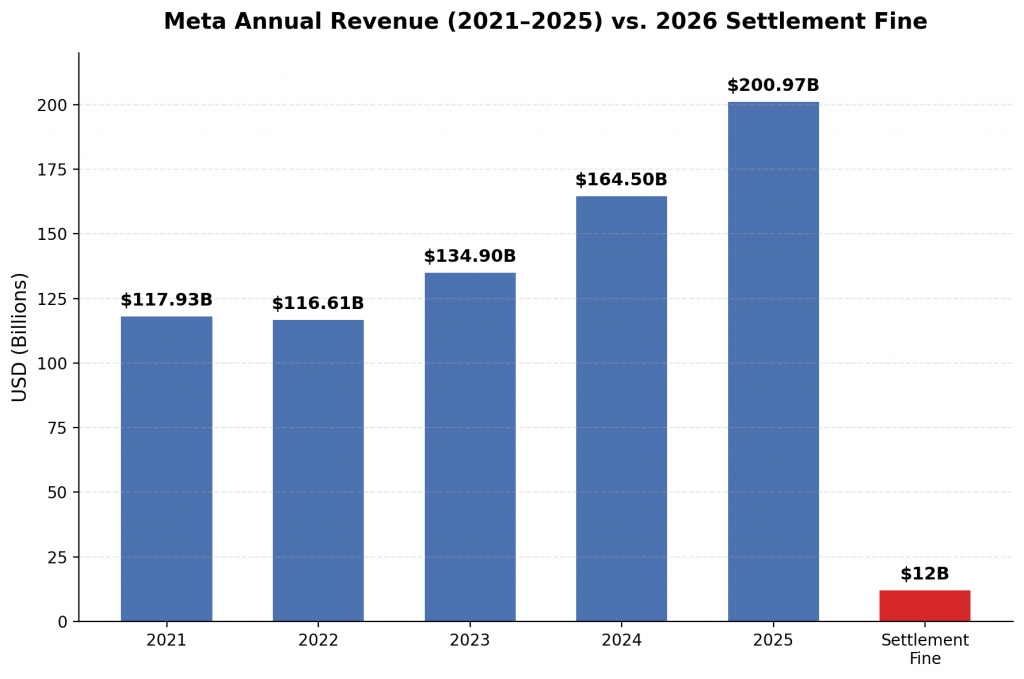
The company has agreed to a settlement worth roughly $12 billion with participating states over allegations that Facebook and Instagram harmed young users.
Around $12 billion is part of the agreement now, while another roughly $5 billion depends on other major platforms, including YouTube and TikTok, adopting similar protections.
The proposed changes include a default two-hour daily limit for teenagers, along with “night” and “school” modes designed to block the apps or reduce notifications at certain times.
These measures do not address the deeper problem. Former Facebook employee and whistleblower Arturo Béjar compared the two-hour limit to telling someone they can smoke as many cigarettes as they want within two hours. His point is that limiting exposure does not necessarily make the product safer. Amba Kak, co-executive director of the AI Now Institute and a former senior adviser at the Federal Trade Commission, makes a similar argument. She says the settlement focuses on design changes without addressing the business model that drives platforms to maximize engagement and attention through surveillance advertising.
That business model has been enormously profitable. Meta reported $200.97 billion in revenue in 2025, much of it generated by advertising across its family of apps, including Facebook and Instagram. A settlement worth $17 billion sounds enormous, but spread over ten years, it represents a relatively small cost for a company of Meta’s size.
Are governments changing the system that produces the harm?
The timing makes that question even more important. While governments are finally confronting the consequences of social media, Meta is investing heavily in AI. It is building data centers, developing AI agents and putting AI into consumer products, presenting the technology as a central part of its future.
And governments are helping build that future. In the United States, policymakers are supporting the rapid expansion of AI infrastructure, which requires enormous amounts of electricity, land, water and investment. Europe is facing the same tension. The European Union has taken a tougher regulatory approach to social media, investigating platforms such as Facebook, Instagram and TikTok over addictive design and protections for minors. At the same time, it is investing in AI computing capacity and infrastructure to compete with the U.S. and China.
The contradiction is hard to ignore: governments are regulating the technology of yesterday while helping build the technology of tomorrow.
The Meta settlement may be significant, especially if YouTube and TikTok follow the same rules. But the bigger question is what accountability actually means when a company can make hundreds of billions of dollars from a business that produces serious social costs, pay a comparatively small portion back through a settlement, and then move its attention to the next technological frontier.
If a technology can generate enormous profits while leaving society to absorb its costs—mental health problems, privacy concerns, social disruption or environmental pressure—who ultimately pays? And if governments wait until the damage is already widespread, is a fine enough?
Meta is now being asked to pay for some of the consequences of the social media era. But the company is already moving on to AI, with governments helping it along the way. The question is whether we will repeat the same cycle: allow a technology to grow first, discover its costs later, and only then ask whether we should have regulated it from the beginning.