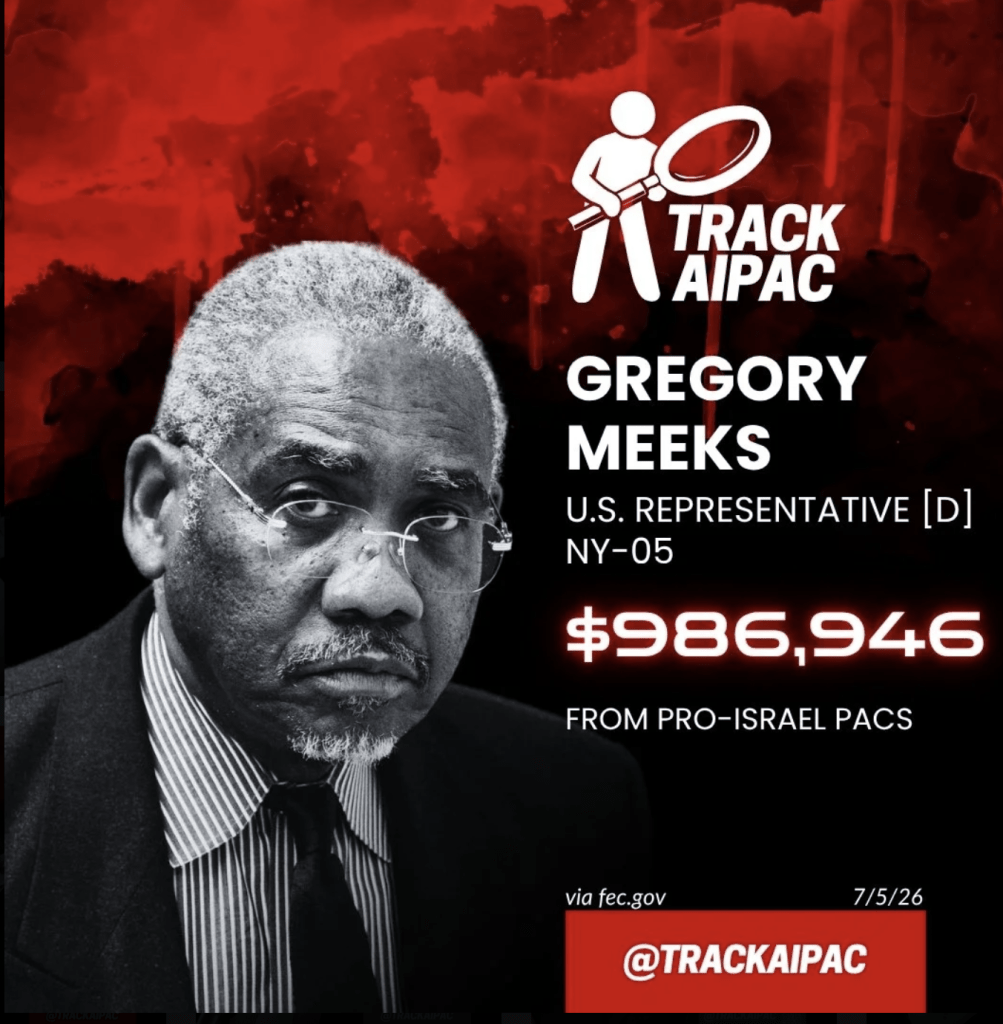
Meeks has put the massive arms deal with Israel sought by Trump on hold. Is he breaking with the past? This is how the politics of the liberal Zionist lobby works: it does not stop the genocide.
Since yesterday, Gregory Meeks’s name has been in the spotlight for placing a hold on the $2.8 billion massive arms deal sought by the Trump administration for Israel: 40,000 2,000-pound bombs, among the most destructive munitions in the U.S. arsenal.
Meeks is the Ranking Member, that is, the leading Democratic member, of the House Foreign Affairs Committee. It is in this position that he has used the committee’s informal review power to put the sale on hold, arguing that he had not received sufficient assurances that these weapons “will be used in accordance with U.S. law and with adequate protections for civilians.”
Is Meeks a hero?
Reading only the BBC headline, it might seem so: Top Democrat opposes US sale of heavy bombs to Israel.
But it is necessary to look at what Meeks did just two months ago.
On July 15, 2026, he voted against the Massie amendment that would have eliminated $3.3 billion destined for Israel through Foreign Military Financing. The amendment was defeated 104–314. But the politically significant fact here is this: 103 Democrats voted in favor, while 98 voted against. Meeks was among the latter.
Today, the decision to put this specific arms deal on hold has nothing of a break with the past. And indeed, in the statement announcing the hold, Meeks is careful to specify that “this decision does not diminish Congress’s support for Israel’s legitimate defense needs.”
The same dynamic had already been seen in 2024
In April, Meeks had informally blocked the sale of 50 F-15s to Israel, then worth more than $18 billion, asking for greater assurances regarding the use of the weapons, the protection of civilians, and access for humanitarian aid.
In June, after months of pressure from the Biden administration, Meeks and Senator Ben Cardin gave the green light to the sale. Meeks explained that he had remained in close contact with the White House and reiterated his support for Israel’s security.
It is therefore not simply the individual episode of 2026 that is interesting, but the repetition of the pattern: a massive arms deal, public concern for civilians, an institutional intervention that slows down the process, and, finally, a reaffirmation of support for the military alliance with Israel.
And we are talking about enormous figures. In 2024, a deal worth more than $18 billion for 50 F-15s; in 2026, 40,000 2,000-pound bombs for $2.8 billion. The scale of these supplies makes the distance between the size of the military operations and the limited nature of individual gestures of dissent even more evident.
Then there is the timing
Meeks is running for reelection in New York’s 5th Congressional District, which includes part of Queens. Today, September 17, there are 47 days left before the November 3 vote. His hold therefore comes in the middle of the midterm campaign, at a time when U.S. support for Israel is a controversial issue within the Democratic Party. In 2024 as well, his position on the sale of F-15s came just months before the November elections: the first hold dates back to April, while final approval of the sale came in June.
Finally, there is the AIPAC chapter
In the 2022–2026 electoral cycle, Meeks’s campaign received $752,817 in direct contributions from the AIPAC PAC, according to FEC data compiled by FundVoter. The figure represents approximately 43.1% of the $1.74 million raised by the campaign during the 2026 cycle. This figure concerns direct contributions only: any independent expenditures by the AIPAC-affiliated super PAC, United Democracy Project, are accounted for separately and, in the database consulted, are still unavailable.
Meeks supports structural military funding for Israel, as demonstrated by his July vote; at the same time, he exercises his institutional power to put a specific massive bomb sale on hold; and he does so as the midterm elections approach and while his campaign has received significant financial support from the AIPAC PAC.
It is this tension between distancing and continuity, between the demand to protect civilians and the reaffirmation of support for Israel’s security, that constitutes the political practice of liberal Zionism: a theoretical exercise in dissent that never truly calls the overall framework into question. Before the voters and before the law, there is always “Israel’s security.”